Home / About LSDs / Fabry Disease
Fabry Disease: Symptoms, Treatment and Support in India
Fabry disease is a rare inherited disorder in which a fatty substance builds up in blood vessels, nerves, the kidneys and the heart. It affects both men and women, and treatment is available.
Key facts
Cause
Deficiency of the enzyme alpha-galactosidase A (GLA gene)
Inheritance
X-linked; affects both males and females
Mainly affects
Nerves, skin, kidneys, heart and the blood vessels of the brain
First signs
Often burning pain in the hands and feet in childhood
Treatment
Enzyme replacement therapy (ERT) and oral chaperone therapy
LSDSS community
20+ registered Fabry families across India
On this page:
Overview
What is Fabry disease?
Fabry disease is a rare genetic disorder in which the body cannot break down a fatty substance called globotriaosylceramide (Gb3). This happens because of a deficiency of the enzyme alpha-galactosidase A.
Gb3 slowly builds up in the walls of small blood vessels, in nerves and in organs. In childhood this often causes nerve pain, stomach problems and reduced sweating. In adulthood it can damage the kidneys, heart and brain, leading to kidney failure, heart disease and strokes at a young age.
Fabry disease affects both men and women. Women often have milder or later symptoms, but some develop serious organ problems.
Video: Fabry disease explained (credit: Osmosis)
Fabry disease in India
Fabry disease is estimated to affect 1 in 40,000 to 1 in 117,000 people worldwide, and newborn screening studies suggest that milder, later-onset forms may be more common than once thought. In India, many patients remain undiagnosed.
Children with Fabry pain are often told they have “growing pains” or arthritis, and adults may be treated for kidney or heart disease for years before the cause is found. Fabry disease should be considered in young people with unexplained kidney disease, a thickened heart muscle or a stroke.
Did you know?
Testing the family of one person with Fabry disease often finds several more affected relatives.
Because the gene is on the X chromosome, parents, brothers, sisters, children and other relatives may all be at risk.
Types of Fabry disease
Fabry disease varies widely, depending on how much working enzyme a person has and whether they are male or female.
Classic Fabry disease
Usually seen in males with little or no enzyme activity. Symptoms start in childhood or adolescence, with nerve pain, skin spots, reduced sweating and stomach problems, followed by kidney, heart and brain problems in adulthood.
Later-onset Fabry disease
People have some working enzyme. Symptoms usually start in adulthood, often from the 30s onwards, and may be limited to one organ, most often the heart or kidneys.
Fabry disease in women
Women with one changed copy of the gene can have anything from no symptoms to disease as severe as in men. They can develop heart, kidney and brain complications and need regular check-ups.
Signs and symptoms
Symptoms of Fabry disease
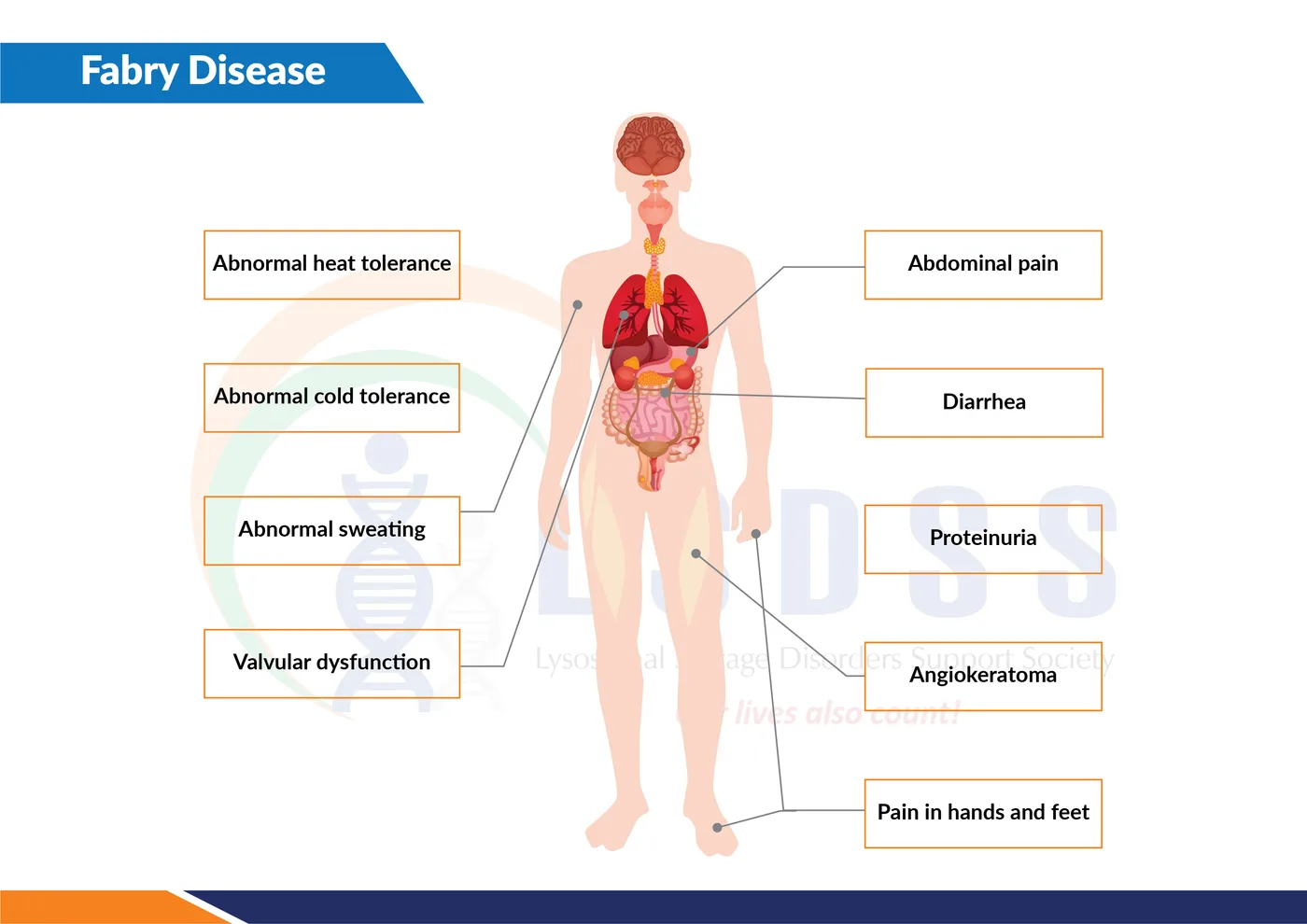
Symptoms vary greatly, even within the same family. Common signs include:
- Burning pain or tingling in the hands and feet, often triggered by heat, exercise or fever
- Reduced or no sweating, and poor tolerance of heat, cold or exercise
- Small dark red spots on the skin (angiokeratomas), often between the belly button and knees
- Stomach pain, diarrhoea, nausea or feeling full quickly
- Hearing loss and ringing in the ears (tinnitus)
- Protein in the urine, kidney disease, heart problems or a stroke at a young age
When to see a doctor
Consult a doctor, ideally a geneticist, nephrologist or neurologist, if you or your child has:
- Repeated burning pain in the hands or feet
- Little or no sweating
- Unexplained kidney disease or protein in the urine
- A thickened heart muscle or a stroke at a young age
Clouding of the cornea, seen in an eye examination, is another clue. It does not usually affect sight.
Causes
What causes Fabry disease?
Fabry disease is caused by changes (mutations) in the GLA gene, which gives the body instructions to make the enzyme alpha-galactosidase A.
When the enzyme is missing or works poorly, Gb3 and related fats build up in cells throughout the body, particularly in blood vessels, nerves, the kidneys and the heart.
How it is inherited
- The GLA gene is on the X chromosome, so Fabry disease is inherited in an X-linked pattern.
- A father with Fabry disease passes the gene to all his daughters but none of his sons.
- A mother with the gene has a 1 in 2 (50%) chance of passing it to each child, son or daughter.
- Genetic counselling and family screening help relatives find out their risk.
How is Fabry disease diagnosed?
The right test depends on whether the person being tested is male or female.
01
Enzyme test
In males, a blood test showing low alpha-galactosidase A activity confirms Fabry disease. Women often have normal enzyme levels, so this test alone can miss it.
02
Genetic test
Finding a change in the GLA gene confirms the diagnosis and is the key test for women and girls. It also helps test other family members.
03
Lyso-Gb3 blood test
Measures a substance that is raised in Fabry disease. It supports the diagnosis and helps monitor how the disease responds to treatment.
04
Organ check-ups
Kidney function and urine protein tests, an ECG, an echocardiogram or heart MRI, brain MRI, hearing tests and an eye examination show how the disease is affecting the body.
Treatment for Fabry disease
There is no cure yet, but treatment can reduce symptoms and help protect the kidneys, heart and brain, especially when started early.
Enzyme replacement therapy (ERT)
The missing enzyme is given as an intravenous infusion, usually every two weeks, for life. ERT can reduce pain and help to slow damage to the kidneys and heart.
Medicines include
- Agalsidase beta (Fabrazyme®)
- Agalsidase alfa (Replagal®)
- Pegunigalsidase alfa (Elfabrio®)
Oral chaperone therapy
A capsule taken every other day that helps the body’s own enzyme work better. It is suitable only for people with certain “amenable” GLA gene changes, which a genetic test can identify.
Medicines include
- Migalastat (Galafold®)
Supportive and long-term care
Depending on their symptoms, patients may also need:
This can include
- Medicines for nerve pain
- Medicines to protect the kidneys and reduce urine protein
- Heart care and stroke prevention
- Dialysis or a kidney transplant in advanced kidney disease
Gene therapies for Fabry disease are being studied. To find ongoing or upcoming clinical trials in India, visit ClinicalTrials.gov.
Clinical trials and studies in India
Studies of Fabry disease that are recruiting, or about to recruit, in India. This list updates automatically every day.
- A Study of Replagal in Children and Adults With Fabry Disease in IndiaRecruitingPhase 4 treatment trial · ShireSites in India: Kolkata, New Delhi
- Fabry Disease Registry & Pregnancy Sub-registryRecruitingObservational study or registry · Genzyme, a Sanofi CompanySites in India: Ahmedabad, Kolkata, Secunderabad, Vellore
Last checked 10 November 2026 on ClinicalTrials.gov. Always talk to your doctor before joining a study.
Accessing treatment in India
Getting treatment and financial support
Treatment for Fabry disease is lifelong and expensive, costing from several lakhs to a few crore rupees a year. These are the main sources of help.
Government support (NPRD)
Fabry disease is listed under the National Policy for Rare Diseases. Eligible patients can receive financial assistance of up to ₹50 lakh for treatment at a designated Centre of Excellence (COE).
- Visit your nearest COE with all medical reports
- Assistance is subject to approval
- The ₹50 lakh limit may not cover lifelong treatment
Other sources of help
- State government schemes
- Corporate social responsibility (CSR) funding
- Crowdfunding through the government rare disease portal
- Clinical trials, where available
How LSDSS helps
- Connects patients with COEs and specialists
- Guides families through funding applications
- Shares updates on support programmes
- Brings patients and caregivers together
Frequently asked questions
Answers to common questions about Fabry disease.
Still have a question?
A rare inherited disorder in which a deficiency of the enzyme alpha-galactosidase A causes a fatty substance called Gb3 to build up in blood vessels, nerves and organs such as the kidneys, heart and brain.
People with Fabry disease lack, or have too little of, the enzyme alpha-galactosidase A, because of changes in the GLA gene. Without it, a fatty substance called Gb3 builds up in the body. This is why Fabry disease is also called alpha-galactosidase A deficiency.
Yes. Although the gene is on the X chromosome, Fabry disease is not only a male disease. Women with one changed copy of the gene can have symptoms ranging from none to severe, and need regular check-ups and, in some cases, treatment.
The earliest signs often appear in childhood: burning pain or tingling in the hands and feet, reduced sweating, poor tolerance of heat or exercise, stomach pain and diarrhoea, and small dark red spots on the skin.
A large registry study published in 2009 reported an average life expectancy of about 58 years for men and 75 years for women with Fabry disease, mainly because of kidney failure, heart disease and stroke. Early diagnosis, treatment and good care of the kidneys and heart can improve the outlook.
Not yet. ERT and oral chaperone therapy can manage the disease, and gene therapies are being studied in clinical trials.
Because it is genetic, it cannot be prevented in the usual sense. But early diagnosis and treatment can help prevent or delay damage to the kidneys, heart and brain, and testing relatives can find people who need monitoring. Genetic counselling, carrier testing and prenatal testing can help families make informed choices.
It is X-linked. A father with Fabry disease passes the gene to all his daughters but none of his sons. A mother with the gene has a 50% chance of passing it to each child. This is why relatives of a diagnosed person should be tested.
First, visit your nearest Centre of Excellence (COE) with all medical reports, to be evaluated and enrolled on the Government of India’s rare disease portal for crowdfunding and CSR donations. Second, register with LSDSS for support and the latest information. Companies that provided free treatment through charitable access programmes were not accepting new patients at the time of writing, so please check with us for the latest position.
Other lysosomal storage disorders
LSDSS supports patients and families living with all lysosomal storage disorders.
A fatty substance builds up in nerve cells of the brain and spinal cord.
Sulfatides build up and damage the protective covering of nerves.
A fatty substance builds up in nerve cells and, in babies, in other organs and bones.
Waste material builds up in nerve cells, causing seizures and loss of vision.
Living with Fabry disease?
Register with LSDSS for treatment guidance, support and the latest updates. You are not alone.
This page is for general information and awareness only. It does not replace advice from a qualified doctor. Last reviewed: November 2026.